Affiliate Disclosure: This post contains affiliate links. When you purchase through these links, we may earn a small commission at no additional cost to you. This helps support the site's research and upkeep.
Should Beginners Buy Vintage Fountain Pens? A Practical First-Pen Guide
A reader recently asked whether a 1970s-1980s Suxi 330 would be good for a beginner in terms of refilling and writing. That is exactly the kind of question where the honest answer is not just about one obscure model. It is about whether a first-time fountain pen user should start with a vintage pen at all.
Short answer: vintage fountain pens can be fun, but they are usually not the best first pen for beginners. If you are still learning how a normal fountain pen should fill, write, clean, and feel, a modern beginner pen is the safer starting point.
Why This Comes Up With Pens Like the Suxi 330
Some older pens, including less common Chinese models, show up in online listings with very little background information. The name may be unfamiliar, the production history may be hard to confirm, and the filling system may not be obvious from a listing title. That does not mean the pen is bad. It means the buyer needs more knowledge before treating it as an easy beginner purchase.
With a common modern pen, you can usually find reviews, nib-size comparisons, cartridge compatibility notes, and replacement-part information. With a less common vintage model, you may be judging condition from a few photos and a seller description. That is a much harder first lesson.
The Main Problem: Vintage Pens Hide Condition Risk
A vintage fountain pen is not one fixed product experience. Two pens with the same model name can behave completely differently depending on storage, repair history, ink residue, nib wear, and whether the filling system still seals properly.
| Risk | What a Beginner Feels | Safer Starting Point |
|---|---|---|
| Nib condition | Scratchiness, hard starts, skipping, or poor line control | Buy a current-production pen with an easy return window. |
| Filling system | Leaking, no ink draw, stuck mechanism, or surprise repair cost | Start with cartridges or a simple converter. |
| Parts availability | A cheap pen can become expensive if it needs rare parts or repair work | Choose a model with widely available cartridges, converters, and replacement nibs. |
| Price confidence | It is easy to overpay when model history and sold prices are unclear | Use a modern benchmark pen first so you know what good writing feels like. |
Refilling Can Be the Hard Part
Modern beginner pens usually make refilling straightforward: install a cartridge, or use a converter with bottled ink. Older pens may use squeeze fillers, aerometric-style fillers, pistons, sacs, or unusual internal parts. If those parts are healthy, the pen may fill well. If they are old, cracked, stuck, or poorly sealed, the pen may not draw ink or may leak after filling.
That is why the question "is it easy to refill?" depends less on the model name and more on the condition of the exact pen in front of you. A restored vintage pen from a knowledgeable seller is very different from an untested pen found in a drawer.
Writing Quality Also Depends on the Individual Pen
Vintage pens can write beautifully. They can also write terribly if the nib is bent, the tines are misaligned, the feed is clogged, or the pen was stored with dried ink for decades. A beginner may not know whether a bad writing experience is caused by the pen, the ink, the paper, the writing angle, or normal fountain pen learning curve.
That is the biggest reason to learn on a predictable modern pen first. Once you know what a reliable fountain pen feels like, you can evaluate vintage pens more calmly.
Better First Pens Before You Try Vintage
If your goal is to learn fountain pens instead of learning vintage repair, start with a current-production pen that has predictable parts, easy refilling, and lots of owner experience online.

Pilot Kakuno
learning nib angle, grip, and cartridge filling without old-pen variables
Check Pilot Kakuno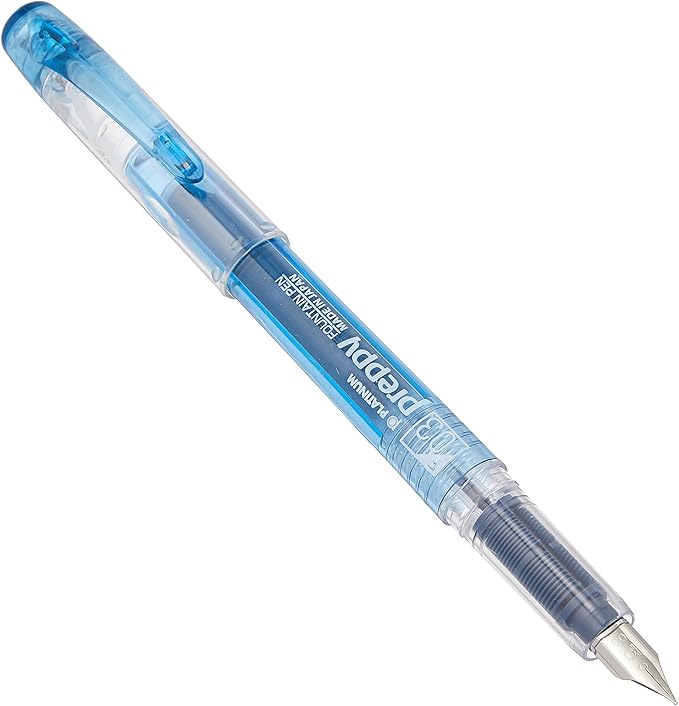
Platinum Preppy
the lowest-cost way to feel reliable ink flow before buying used pens
Check Platinum Preppy
Pilot Metropolitan
a sturdier first daily pen with predictable modern parts
Check Pilot MetropolitanWhen a Vintage Pen Can Make Sense
This is not a rule against vintage pens. It is a rule against making an unknown old pen your only first fountain pen. A vintage pen can make sense if you enjoy research, accept some uncertainty, and understand that the real cost may include cleaning tools, replacement parts, or professional repair.
A beginner can reasonably buy a vintage pen when the seller provides a recent writing sample, clear photos of the nib, proof that the filler works, and a fair return policy. It also helps if the model is common enough that repair notes and spare parts are easy to find.
Ask These Questions Before Buying an Old Pen
Does the seller show a recent writing sample?
A pretty old pen can still have misaligned tines, poor flow, or a damaged feed.
Does the filling system actually draw and hold ink?
Old squeeze fillers, sacs, seals, pistons, and converters can fail even when the pen looks clean.
Can you return it if it leaks or will not write?
Beginner buyers need a safety net because condition problems are hard to judge from photos.
Is the price based on real sold listings?
Vintage pen prices are less transparent than modern retail prices, especially for obscure models.
If You Already Own the Vintage Pen
If the pen is already in your hand, you do not need to throw it away or avoid it forever. Treat it as a careful test project.
- Flush it gently with cool water until the water runs clear.
- Use a safe, washable fountain pen ink for the first test fill.
- Do not use shimmer ink, India ink, calligraphy ink, or waterproof pigment ink for the first test.
- Write for a few pages and watch for leaks, hard starts, skipping, or ink starvation.
- If it leaks or will not fill, stop and look for model-specific repair advice before forcing anything.
Final Recommendation
For a first fountain pen, choose a modern, inexpensive, easy-to-refill model first. Use that pen to learn nib feel, ink flow, cleaning, paper behavior, and what normal writing should feel like. After that, vintage pens become much easier to judge.
A Suxi 330 or another obscure old pen may be interesting, but it is better treated as a vintage curiosity than as the safest first step into fountain pens.
FAQ
Are vintage fountain pens better than modern beginner pens?
Sometimes, but not automatically. A well-restored vintage pen can be excellent. An untested vintage pen can be frustrating. Modern beginner pens are usually more predictable.
Can I use modern fountain pen ink in an old pen?
In many cases, yes, but start with a gentle, washable fountain pen ink. Avoid shimmer, India ink, dip-pen ink, and heavy waterproof inks until you know the pen is clean and healthy.
Is a cheap vintage pen a good deal?
Only if it works or you are comfortable fixing it. A cheap old pen that needs a sac, seal, nib work, or professional cleaning may cost more than a reliable modern starter pen.
What should I buy before trying vintage pens?
Buy one reliable modern pen, one safe ink, and one notebook that handles fountain pen ink well. Once you understand that baseline, vintage pens are much easier to evaluate.